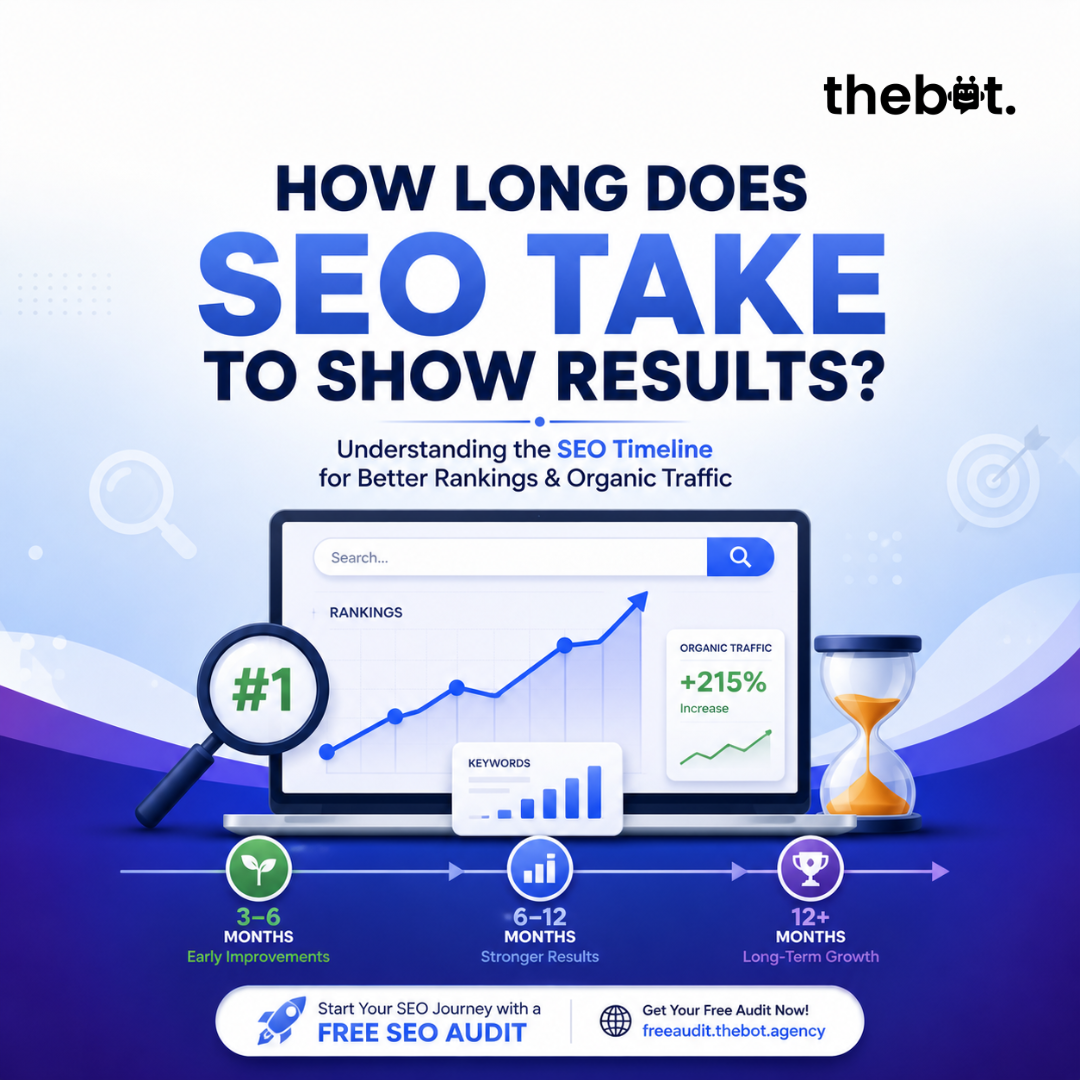
How Long Does SEO Take to Show Results? | The Bot Agency
In this article:
Learn how long SEO takes to show results, what affects SEO growth, and how consistent SEO strategies can improve rankings, organic traffic, and leads.
Introduction
SEO is one of the most effective ways to improve your website’s visibility on Google and attract more potential customers. But one common question businesses ask is: “How long does SEO take to show results?”
The simple answer is that SEO takes time. Most websites may start seeing early improvements within 3 to 6 months, while stronger and more consistent results can take 6 to 12 months or longer. The timeline depends on competition, website condition, content quality, keywords, and the SEO strategy used.
Problem Statement
Many businesses expect SEO results within a few weeks. When they do not see immediate changes, they may think SEO is not working.
Some common problems include:
- Low website visibility on Google
- High competition for important keywords
- Poor website structure
- Slow website performance
- Missing or weak website content
- Incorrect keyword targeting
- Few quality backlinks
- Lack of regular SEO improvements
SEO is not a one-time activity. Search engines need time to crawl, understand, and evaluate website changes. This is why businesses need a proper strategy and consistent SEO work.
How We Solve It
At The Bot Agency, we focus on building SEO results step by step instead of looking for quick shortcuts.
1. Website SEO Audit
We first check the website to identify technical, content, and SEO issues that may affect rankings.
2. Keyword Research
We find relevant keywords based on the business, target audience, competition, and search intent.
3. On-Page SEO
We improve important website elements such as page titles, headings, content, images, internal links, and meta descriptions.
4. Technical SEO
We work on technical factors such as website speed, mobile usability, indexing, site structure, and other technical issues.
5. Quality Content
We create useful and relevant content that answers what potential customers are searching for.
6. Regular Monitoring
SEO performance is regularly monitored to understand keyword rankings, website traffic, and user behaviour. Based on the results, we continue improving the strategy.
Case Study
Consider a business website that was struggling to generate organic traffic because of poor keyword targeting, limited content, and several website SEO issues.
We started by auditing the website and identifying the main problems. Then, we focused on relevant keywords, improved existing pages, created useful content, and fixed important technical SEO issues.
During the first few months, the website began showing improvements in keyword visibility and organic traffic. As SEO work continued, more keywords started ranking and the website received more visitors from search engines.
This shows why SEO should be viewed as a long-term investment rather than a quick marketing campaign. Consistent improvements can gradually lead to stronger rankings, better visibility, and more potential customers.
Conclusion
So, how long does SEO take to show results? There is no fixed timeline for every website. Some businesses may see early changes within a few months, while competitive industries may need more time.
The key to successful SEO is consistent work, the right strategy, quality content, and regular monitoring.
If you want to understand where your website currently stands and what can be improved, you can get a free SEO audit from The Bot Agency:
Frequently Asked Questions
SEO results can usually start appearing within 3 to 6 months. Stronger and more consistent results may take 6 to 12 months or longer, depending on competition and website condition.
Search engines need time to crawl, understand, and evaluate website changes. Competition, website authority, content quality, and technical SEO can also affect the timeline.
Keyword competition, website quality, technical SEO, content, backlinks, search intent, and the consistency of SEO work can all affect how quickly results appear.
Some websites may see early improvements in rankings or traffic within a month, especially after fixing major SEO issues. However, significant and stable results generally take longer.
Businesses can improve SEO results through proper keyword research, quality content, technical SEO, on-page optimization, website improvements, and regular performance monitoring.